
PCOS & Women's Health — Dawi
## The condition more common than you'd think
If your periods have never quite been regular, if your skin or your weight feels like it has a mind of its own, if you've been told to "just lose weight" without anyone explaining why it's so hard — you are far from alone, and there may be a name for it: PCOS, polycystic ovary syndrome.
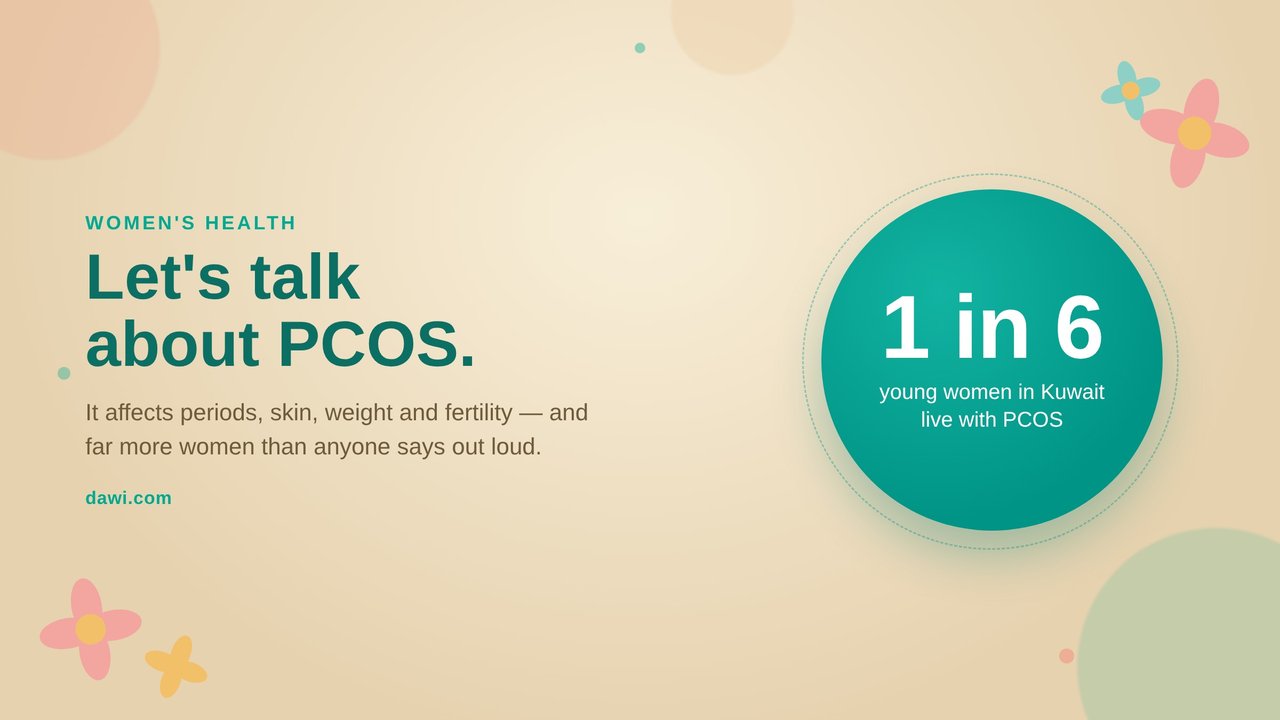
It's one of the most common hormonal conditions in women of reproductive age, yet one of the most quietly carried. A study of young women at Kuwait University found that around one in six had been diagnosed with PCOS — and because many women never get assessed, the true number is almost certainly higher. Acne, irregular periods and unwanted hair growth were reported by large shares of the women studied. In other words: this is everywhere around us, and most of us just don't talk about it.
## What PCOS actually is
Despite the name, PCOS isn't really about cysts, and you don't need to have them to have the condition. At its core it's a hormonal imbalance: the ovaries produce higher-than-usual levels of androgens (hormones all women have, but usually in smaller amounts), and ovulation becomes irregular. Insulin — the hormone that manages blood sugar — is often part of the story too, which is why PCOS, weight and blood sugar are so closely linked.
The result is a cluster of effects that can look different from one woman to the next. That's exactly why it's so often missed: there's no single symptom that defines it, and many of its signs get written off as unrelated annoyances.
## The signs that too often get dismissed
PCOS tends to show up as a combination rather than one clear flag. Periods that are irregular, far apart, or missing. Acne that lingers well beyond the teenage years. Unwanted hair growth on the face, chest or stomach — or, conversely, thinning hair on the scalp. Weight that climbs easily and resists coming off no matter how carefully you eat. Darkened patches of skin in the folds of the neck or underarms. Any one of these alone is easy to shrug off. Together, they tell a story worth listening to.
The real problem isn't the symptoms themselves — it's how normal it's become to dismiss them. "Irregular periods are just how I am." "I've always had bad skin." "I just need more willpower." For too many women, years pass before anyone connects the dots.
## Why it matters beyond your cycle
PCOS is more than an inconvenience, and taking it seriously isn't about alarm — it's about staying ahead of it. Because of the insulin link, women with PCOS have a higher long-term risk of type 2 diabetes and related conditions, which is well worth knowing early in a country where diabetes is already common. It's also one of the leading causes of difficulty conceiving — but, crucially, a very treatable one, and knowing early gives you options and time. And none of that touches the part that rarely makes the medical leaflets.
## The part no one talks about
Living with PCOS can weigh on you in ways that don't show up on a blood test. The skin, the hair, the weight, the uncertainty about fertility — these touch how women feel about themselves, and it's completely understandable to find that hard. If that's you, please know two things: it is not your fault, and you are genuinely not alone in it. The condition is common, the feelings that come with it are valid, and support — medical and emotional — exists. You don't have to carry it quietly.
## The genuinely reassuring part
Here's what often gets lost in the worry: PCOS is very manageable. It isn't something you "catch up to" too late. For many women, everyday steps make a real difference — regular movement, balanced eating that steadies blood sugar, and small sustainable changes rather than crash diets. Alongside that, a doctor can offer targeted options for the specific things that bother you most, whether that's cycle regulation, skin and hair concerns, or planning for pregnancy. The goal isn't a perfect body or a cure overnight — it's understanding your own body and having a plan that fits your life.
## How to get answers
The single most useful thing you can do is stop normalising the signs and get them looked at properly. PCOS is diagnosed by a doctor, through a conversation about your history and simple checks — not by guesswork or an online quiz. If several of the signs above feel familiar, that's reason enough to ask.
With Dawi, you can start that conversation from home — talk to a doctor privately, share what you've been noticing, and get guided to the right assessment and next steps without the awkward wait. Sometimes the hardest part is simply saying it out loud for the first time; this makes that part easy.
## You're not alone
So many women are quietly managing the exact things you might be — and the more we name it, the less alone any of us feels. PCOS is common, it's understood, and it's manageable. If this sounded like you, take it as your sign to ask the question. Knowing is the first step, and it changes everything that comes after.
This article is for general information and is not a substitute for personal medical advice. Speak to a doctor about diagnosis and any concerns.
References
- PCOS among female university students in Kuwait: https://journals.sagepub.com/doi/10.1089/whr.2023.0176
- PCOS prevalence in GCC countries (Heliyon): https://www.cell.com/heliyon/fulltext/S2405-8440(24)16634-0
- Burden of PCOS in MENA, 1990–2019 (Scientific Reports): https://www.nature.com/articles/s41598-022-11006-0